
Missa73
Net Art
Duration: 0 min.
Friday, 09 October 2026 | 12:30 > 12:302026-10-09T12:30:00.000Z | Exhibition Area #4
Year: 2004
Medium: Macromedia Shockwave Flash
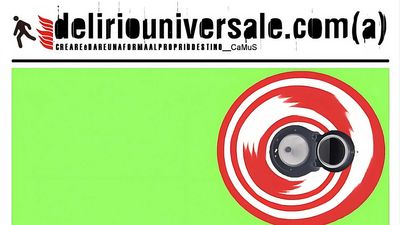
missa73 is a work created around 2004 for deliriouniversale.com(a), in which faces and bodies constructed from collage, photographs and discarded materials are transferred into digital space and animated using Macromedia Flash.
The imagery deliberately retains its physical and handmade origins. Photographic fragments, textures, cut-outs and assembled objects become parts of figures that appear to have been materially constructed before entering the screen. The digital does not erase the traces of physical matter, but sets them in motion, creating a short circuit between collage, animation and the language of the web.
As in other works presented on deliriouniversale.com(a), the human figure is not simply something to be observed. Interactive areas, some immediately visible and others concealed within the image, invite the viewer to explore, click and intervene, changing what happens on screen. The work therefore requires active behaviour: its possibilities have to be searched for and the ways in which the image responds are progressively discovered.
missa73 thus becomes a small interactive puppet theatre contained within the browser. Bodies constructed as physical objects are animated and made manipulable through code, while the mouse becomes the instrument through which the viewer can enter the composition.
Created at a time when Flash was one of the principal territories for creative experimentation on the web, the work belongs to a period when the Internet was still largely a space built by hand, page by page and interaction by interaction. Reactivated today, missa73 preserves not only its images and animations, but also a way of engaging with digital work characteristic of the early 2000s web: exploring, touching, experimenting and discovering.
Medium: Macromedia Shockwave Flash
missa73 is a work created around 2004 for deliriouniversale.com(a), in which faces and bodies constructed from collage, photographs and discarded materials are transferred into digital space and animated using Macromedia Flash.
The imagery deliberately retains its physical and handmade origins. Photographic fragments, textures, cut-outs and assembled objects become parts of figures that appear to have been materially constructed before entering the screen. The digital does not erase the traces of physical matter, but sets them in motion, creating a short circuit between collage, animation and the language of the web.
As in other works presented on deliriouniversale.com(a), the human figure is not simply something to be observed. Interactive areas, some immediately visible and others concealed within the image, invite the viewer to explore, click and intervene, changing what happens on screen. The work therefore requires active behaviour: its possibilities have to be searched for and the ways in which the image responds are progressively discovered.
missa73 thus becomes a small interactive puppet theatre contained within the browser. Bodies constructed as physical objects are animated and made manipulable through code, while the mouse becomes the instrument through which the viewer can enter the composition.
Created at a time when Flash was one of the principal territories for creative experimentation on the web, the work belongs to a period when the Internet was still largely a space built by hand, page by page and interaction by interaction. Reactivated today, missa73 preserves not only its images and animations, but also a way of engaging with digital work characteristic of the early 2000s web: exploring, touching, experimenting and discovering.
Author
 Deliriouniversale.com(a) is an artistic and digital experimentation project that emerged in the early 2000s and is connected to the practices of Nikky / Valeria Guarcini, Chiba / Daniela D'Avino and Dr Doom / Emiliano Fuksas. Based primarily in Rome, the project developed through global collaborations within the first wave of creative web culture, when browsers, Macromedia Flash and digital tools were becoming new territories for constructing images, animations and forms of interaction, both with machines and among the different communities...